In the first semester, I finished an assignment for a course on theories of modernity. The topic was about using a text to help us understand Freud’s The Uncanny. Before taking this course, Professor Graham asked us to find some examples related to Freud’s works. After I read The Uncanny, the first example that appears in my mind is the fear caused by the similarity between artificial intelligence robots and human beings. I think that’s a perfect example of The Uncanny. So I began to search for various works related to it, and finally, I found the Female Figure created by Jordan Wolfson in 2014, which completely conforms to The Uncanny. Due to the word limit of the writing assignment, I can’t write all my thoughts, so I would like to write some other thoughts about The Uncanny here.
The phrase “uncanny” was first defined in 1906 by Ernst Jentsch, a German psychiatrist. Jentsch defined it as something familiar and native that is usually initially perceived negatively. However, Sigmund Freud redefined the concept as a situation where something might be both familiar and alien at the same time in his 1919 work, The Uncanny. Freud believed that “unheimlich” was specifically opposed to the word “heimlich,” which can mean both homely and familiar as well as secret or private (Freud 2). Therefore, he contended that “unheimlich” was not only unknown but also revealed something that was suppressed or hidden. He referred to it as a kind of frightening feeling connected to the known and familiar. Freud claimed that what he refers to as “the return of the repressed” is what causes the uncanny, which is when childhood ideas that we have grown out of become real. Situations like inanimate objects coming alive, having thoughts that seem to affect reality, seeing your double, death representations like ghosts or spirits, and involuntarily repeated actions can all cause an unsettling sense (Jamie Ruers para.10).
The primary concepts that Freud explored about the uncanny are double, repetition, estrangement from the home, blurring of boundaries, and the unsettling familiar. According to Freud, the uncanny is frequently connected to the concept of the “double.” It might be unsettling to see one’s double since it challenges our sense of individuality and distinctiveness. When describing something as a “blurring of boundaries,” it frequently refers to the blending of boundaries separating the animate and inanimate, life and death, or reality and unreality. This blurring can be unsettling since it produces a sense of ambiguity. “Unsettling familiar” often refers to something familiar that has been suppressed or hidden and resurfaces frighteningly. This may involve suppressed memories or subconscious fears. These factors precisely account for the uncanny that the Female Figure invokes in us.
What makes us afraid? What keeps us up at night after watching a horror movie, or what causes us to instantly lock our doors after reading horror fiction? Looking through a list of famous horror characters could help us find a simple and clear answer to this question: we are terrified of things and people that we know but feel difficult to comprehend. Freud defines the fear that arises from an object we are familiar with as the uncanny. Why do we occasionally feel terrified of these familiar objects from the past? Although the talking dolls in Toy Story are attractive and amusing characters, their realistic terror setting is starting to terrify adult audiences. Things like dolls, clowns, and television popped into my mind, as they are things we have had since we were kids. I may have dreamed as a child about talking with dolls, but knowing their artificial elements as an adult, such conversations may be so weird and even unsettling. A familiar inanimate doll that can walk, speak, and think for itself would terrify adults because such a thing is unlikely to happen in real life. While audiences are usually not worried when talking dolls appear on the screen, when they occur in real life, they begin to arouse fear.

Sigmund Freud’s The Uncanny has had a profound impact on psychology, literature, and the arts. It has encouraged many writers and artists to explore uncanny themes in their works. Female Figure, one of Jordan Wolfson’s works, is the ideal representation of Freud’s uncanny theory. Jordan Wolfson’s immersive artwork Female Figure is a robotic sculpture of a woman. Covered in mud and dirt, the sculpture wears a beaky green-black witch mask, a white stripper dress, and a platinum-blond wig. The robot performs monologues and dances to pop music lasting seven to twelve minutes, depending on the version. The sculpture is dynamic and electronic, measuring the same size as a human body. She faces back toward the audience and draws attention with her sexy dance moves and posture, but as people get closer, they will see her real face in the mirror: it is a face like an evil witch complete with a green mask, a large aquiline nose, wrinkles all over her face, and a mouth full of black fangs. The horror of her face and the sexiness of her back form a strong visual impact, intimidating everyone who observes her from behind (Vankin para. 2).

The combination of the stunning beauty on her back and the fear on her face made an intense visual impression that terrified every audience watching her from behind. Additionally, Wolfson gave her an instant sensor so that her eyes could look through a mirror and make eye contact with the audience. A sense of unease and terror is evoked by the robot’s constant stare, which is consistent with Freud’s concepts of the uncanny: humans show an odd fear of the familiar, a tension between the familiar and the unsettling unconscious. This concept, in Freud’s words, is a stressful conflict that combines a sense of familiarity with the unsettling unconscious. The origin of the uncanny could be a commonplace item or activity that unpredictably arouses feelings of fear, unease, and alienation. The Female Figure’s smooth dancing motions add to the audience’s fear when they realize that she is a robot, much like a humanoid robot is a replica of a real human.

Some modern artists’ creations, like Robert Gober’s work, which shows a prosthetic leg protruding from the art gallery wall, also evoke a sense of weirdness and unease. Also, Tony Oursler superimposed human face features onto a malformed body that smiled and moved. The work evokes a strong sensation of oddity in viewers visually, and at the same time, the elements familiar but beyond our cognition enhance our fear of it. Where does the fear of humans originate from while looking at these humanoid sculptures? Freud has stated that humans are anxious about death and Oedipus’s plots, and when humans see objects like artificial limbs, talking dolls, twins, and humanoid robots, they inexplicably generate an uncanny response, indicating that some previously suppressed emotions are awakened. The audience is left with uncanny and frightening psychological hints in their subconscious because these things contain both familiar and unfamiliar elements.

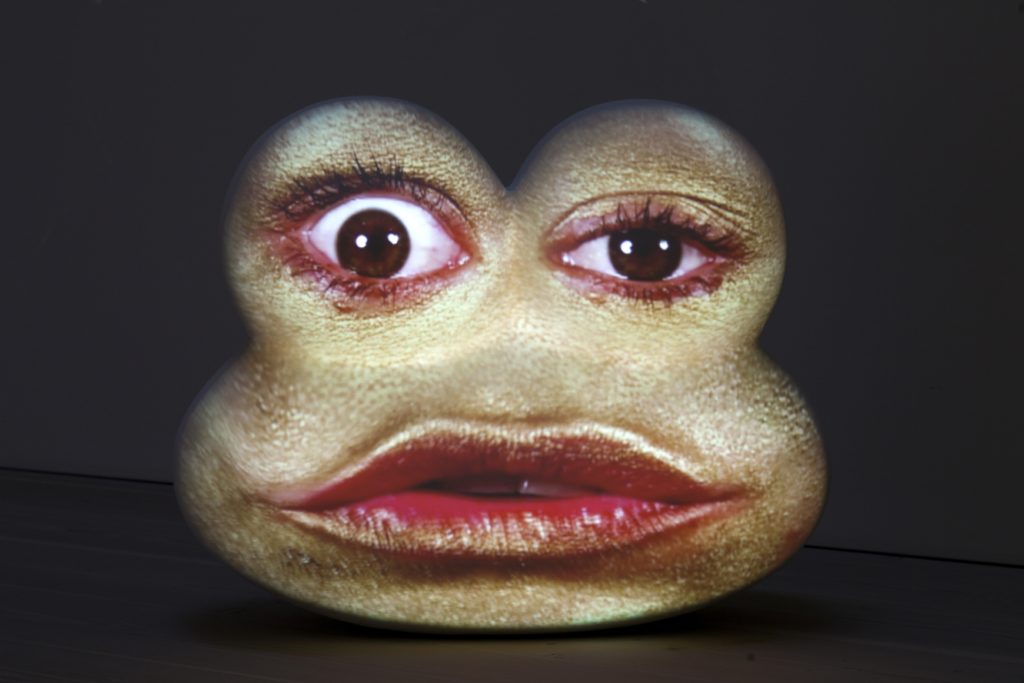
Creative writers may further intensify the horror in their books by depicting scenes that hardly ever happen in reality. This multiplies the uncanny well beyond what could occur in real life. The Female Figure in the exhibition uses a similar tactic. Mysterious and grotesque masks, female bodies with male voices, humanoid bodies with mechanical joints, and smooth dance movements along with noises of mechanical friction are all combined in this work of art. Unheard things of all kinds are mixed to make the audience experience several multiplicities of terror. Through her seductive posture and her eyes gazing at them, especially during the repetitious dance movements, people might see themselves reflected in the mirror, as if they were seeing the ghost of their deepest fears in a huge reflected object.
In a word, Freud’s theory of The Uncanny allows us to explore the deeper psychological and emotional elements of artistic creations by highlighting the tension between the familiar and the unsettling. As a result, it can be a useful lens through which to evaluate and analyze artistic creations. In addition to the basic sensory stimulation, the deeper anxiety connected to the uncanny of the Female Figure originates from the disintegration of one’s sense of self. The abrupt unreasonableness makes people doubt their self-awareness, but they also doubt it because they are familiar with the situation as a whole. As the sense of familiarity is steadily eroded by unreasonableness, everything will seem uncanny.
Work Cited
Freud, Sigmund. The “Uncanny.” 1919, web.mit.edu/allanmc/www/freud1.pdf.
Ruers, Jamie. “The Uncanny | Freud Museum London.” Freud Museum London, 18 Sept. 2019, www.freud.org.uk/2019/09/18/the-uncanny/.
Vankin, Deborah. “Q&A: Jordan Wolfson’s Robot-Sculpture Finds a Home at the Broad Museum.” Los Angeles Times, 30 Dec. 2014, www.latimes.com/entertainment/arts/culture/la-et-cm-jordan-wolfson-female-figure-broad-museum-20141223-story.html.